Why Insider Risk Needs a Common Metrics Language
“Insider risk cannot mature as a discipline until it can be measured consistently.”
Insider risk has no shortage of attention. Security leaders talk about data loss, misuse of access, policy violations, workforce-related risk, and operational blind spots every day. Boards hear about sensitive incidents. Teams invest in controls, investigations, awareness efforts, and governance processes. Yet for all that activity, many organizations still lack something fundamental: a common way to measure insider risk.
That gap matters more than it may seem. When a program cannot describe exposure consistently, it becomes difficult to compare parts of the business, justify investments, prioritize action, or prove that posture is improving. Conversations remain qualitative. Reporting becomes episodic. Decision-making leans too heavily on instinct, anecdotes, and whichever incident is freshest in memory.
The core challenge:
That is why insider risk needs a common metrics language.
Not a single magic score. Not another dashboard full of disconnected counts. A real measurement framework should help organizations answer the same core questions, in a repeatable way, over time.
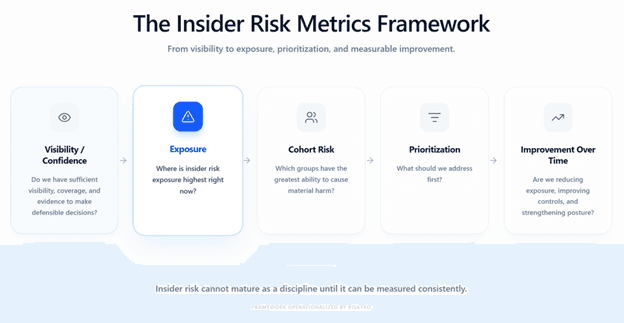
Figure 1: The Insider Risk Metrics Framework — from visibility to exposure, cohort risk, prioritization, and measurable improvement.
Most insider risk programs already have numbers. They can usually report alert volume, case counts, training completion rates, policy exceptions, or investigation activity. But having numbers is not the same as having a measurement system.
Case counts are the clearest example. They are easy to collect, easy to chart, and easy to discuss. But on their own, they are a weak proxy for risk. An increase in cases may reflect growing exposure. It may also mean detection improved. A decline may look reassuring, even if visibility is poor and meaningful behavior is simply not being seen. Raw counts tell you what surfaced. They do not necessarily tell you what exists.
That distinction is where many programs get stuck.
Executive stakeholders do not really want a summary of activity. They want defensible answers to practical questions. Where are we most exposed right now? Which groups deserve attention first? What should we address before something becomes a more serious problem? Are current investments actually reducing risk? If the only answers available are “we opened twelve cases last quarter” or “alerts were down this month,” the program is still speaking in activity, not in exposure, prioritization, or progress.
A stronger discipline starts with a shared framework.
At a high level, insider risk metrics should help organizations answer five questions:
1. Visibility / Confidence
Do we have sufficient visibility, coverage, and evidence to make defensible decisions? Before any organization claims a risk is high or low, it should understand how much signal it actually has. False precision is dangerous. A number only becomes useful when the underlying evidence is strong enough to support action.
2. Exposure
Where is insider risk exposure highest, and what is driving it? This is the center of the framework because it shifts the conversation away from isolated incidents and toward present conditions. Exposure is not just about what has already happened. It is about where the organization is most meaningfully vulnerable now.
3. Cohort Risk
Which groups have the greatest ability to cause material harm? Insider risk is rarely distributed evenly. Certain roles, business units, functions, or access profiles may have more opportunity, more reach, or more potential impact than others. A useful metrics language should make that concentration visible, rather than assuming risk is spread uniformly across the enterprise.
4. Prioritization
Which gaps, risks, and actions matter most right now? This is where metrics become operational. The goal is not to sound more analytical. The goal is to decide what to address first, what can wait, and where limited resources will reduce the greatest amount of exposure.
5. Improvement Over Time
Are we reducing exposure, improving controls, and strengthening posture? No serious risk discipline can mature without a way to show change. That does not mean celebrating lower incident counts in isolation. It means understanding whether the organization is more visible, less exposed, better controlled, and better positioned to act than it was before.
Seen together, these five questions do something important: they turn insider risk from a loosely defined concern into a management discipline.
They make reporting more defensible. They give operators clearer signals for action. They help leaders connect budgets to outcomes. They create a more consistent language across security, legal, compliance, HR, and business stakeholders. Most of all, they make it possible to talk about insider risk as something that can be measured, compared, and improved, rather than simply reacted to.
This is also why so many current reporting models fall short.
One common mistake is equating incidents with exposure. Incidents matter, but they are a lagging and incomplete picture. Another is confusing activity with risk, as though more alerts or more exceptions automatically mean greater danger. Another is comparing raw counts across groups that are not actually comparable because size, role, access, and coverage differ. Another is reporting severity without acknowledging confidence. And another is treating metrics as static snapshots instead of something that should show movement, concentration, and change.
Note on Impact:
These are not cosmetic reporting issues. They shape real decisions.
If measurement is weak, prioritization becomes weak. If prioritization is weak, investment becomes reactive. If investment becomes reactive, programs struggle to prove that they are improving posture in a meaningful way. Over time, that makes insider risk harder to govern, harder to explain, and harder to advance as a serious discipline.
That is why the case for a common metrics language is not theoretical.
Insider risk programs are increasingly expected to do more than investigate events after the fact. They are expected to support governance, guide prevention, justify spending, inform leadership, and demonstrate measurable improvement. That requires more than incidents and case counts. It requires measures that are repeatable, decision-useful, and comparable over time.
The good news is that the conceptual framework is not especially complicated. The harder part is operationalizing it consistently in the real world. Data is fragmented. Coverage varies. Different parts of the organization are not directly comparable. The quality of a metric can shift as visibility improves. What seems simple in a workshop becomes much harder when teams try to compute, normalize, and track these measures consistently over time. That challenge should not discourage organizations. It should clarify the opportunity.
The teams that build a real measurement discipline around insider risk will be better positioned to prioritize action, justify investment, and show risk reduction with credibility. They will be able to answer more than “what happened?” They will be able to answer “where are we exposed, what matters most, and are we improving?”
I believe insider risk cannot mature as a discipline until it can be measured consistently. The goal is not to reduce a complex problem to a single number. It is to establish a practical, shared language for visibility, exposure, cohort risk, prioritization, and measurable improvement.
In the next post, I will examine the natural follow-on question: what makes a good insider risk metric in the first place?